


Why Does Marine Decking Need Heat?
In EVA marine decking production and installation, “heating” can mean two very different processes: production heat-setting and controlled pre-installation warming. Each has a specific purpose, and neither means that more heat is always better.
Production heat-setting can help release internal stress, improve dimensional stability, and prepare EVA foam for accurate processing.
Controlled pre-installation warming may improve flexibility, surface conformity, and initial pressure-sensitive adhesive contact in cold conditions.
1. Why Is Heat-Setting Used During Production?
Releasing internal material stress
EVA foam can develop internal stress during foaming, lamination, compression, rolling, storage, and transportation. If it is cut, engraved, or laminated before it has stabilized, later exposure to sunlight and temperature changes may reveal slight shrinkage, warping, or dimensional movement.
Controlled thermal conditioning can release part of this stress before final machining. This is especially important for custom marine decking, where even a small dimensional change may affect seams, borders, and the fit around hatches, cleats, consoles, and other deck hardware.
Improving dimensional stability
Marine decks are regularly exposed to sunlight, heat cycles, moisture, and changing weather. Foam that has not been properly stabilized may change dimensions after entering service. Production heat-setting helps condition the material before it is converted into a finished kit, reducing uncertainty during later thermal exposure.
Heat-setting does not make EVA permanently immune to shrinkage or expansion. Performance also depends on the foam formulation, density, crosslinking, thickness, laminated construction, and process control. A reliable manufacturer validates the process for each material system rather than applying one temperature and time setting to every foam.
Supporting consistent lamination and surface quality
Multi-layer EVA decking may combine foams with different colors, densities, or textures. A controlled heat-and-pressure process can help maintain a consistent laminated structure and create a more uniform base for brushing, embossing, routing, and CNC engraving.
Uneven heating may cause local thickness variation, surface distortion, or inconsistent stress between layers. Professional process control therefore considers not only temperature, but also heating uniformity, pressure, dwell time, and cooling.
Creating a stable base for precise CNC machining
Custom deck kits are commonly cut and engraved from scans, templates, or CAD files. The more stable the material is, the easier it is to maintain accurate dimensions, seam spacing, border alignment, and pattern placement.
If substantial stress is released only after cutting, an accurate digital file may still produce components that shift at the edges or no longer meet consistently. Production heat-setting is therefore not just a material issue; it is also part of dimensional and installation quality control.
2. Why Might Marine Decking Be Warmed Before Installation?
Pre-installation warming is not mandatory in every environment. It is mainly relevant when low temperatures make the foam or adhesive less suitable for installation.
Restoring flexibility in cold conditions
Cold EVA foam can temporarily feel stiffer. Thick pads and mildly curved areas may therefore be more difficult to fit. Gentle, even warming can help the decking recover its normal flexibility and conform more easily to slight deck contours.
Heat should not be used to force an unsuitable part onto a sharply curved or incorrectly measured surface. If the curvature is excessive, the template is inaccurate, or the panel design is unsuitable, the correct solution is to review the design and segmentation—not to apply more heat.
Improving initial pressure-sensitive adhesive contact
Many self-adhesive EVA deck pads use pressure-sensitive adhesive. This adhesive needs suitable surface temperature, cleanliness, and installation pressure to make full contact with the deck. In cold conditions, the adhesive may become less compliant, reducing initial wet-out and tack.
Controlled warming of the pad, adhesive layer, or installation surface may improve initial contact. However, heat cannot replace correct surface preparation. Oil, wax, water, dust, aged coatings, cleaning residue, or an incompatible substrate may still cause bond failure.
Helping the material relax after shipping
Marine decking may be rolled or stacked for transportation. After unpacking, it should be laid flat and allowed to relax before installation. This recovery can take longer in a cold environment. A gently warmed room may help, but natural flat conditioning should remain the first choice. Concentrated heat should not be used to “bake” a rolled pad flat quickly.
3. What Can Happen When Heating Is Insufficient?
When production heat-setting or cold-weather warming is genuinely required, insufficient conditioning may increase the risk of:
- Residual stress and later dimensional movement
- Seam or edge misalignment after CNC cutting
- Reduced flexibility during installation on mild contours
- Weak initial pressure-sensitive adhesive contact and lifted edges
- Incomplete recovery from rolling or stacked transportation
These symptoms are not always caused by insufficient heat. Foam formulation, template errors, deck contamination, inadequate pressure, and incorrect adhesive selection can create similar problems. Heating should therefore be treated as one part of a controlled system, not as a universal explanation or cure.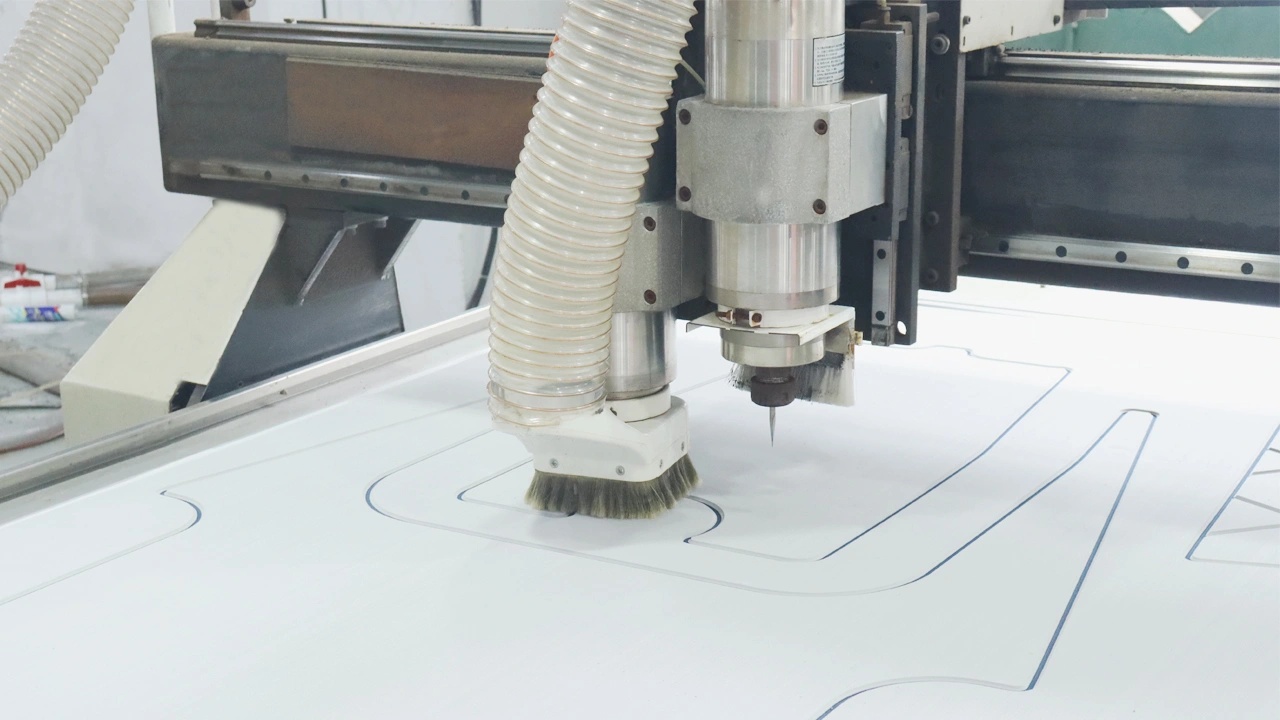
4. Why Is Excessive Heating More Dangerous?
The objective is to bring the foam and adhesive into an appropriate processing range—not to expose them to the highest possible temperature. Excessive or uneven heat may cause:
- Surface softening, gloss, or texture damage
- Localized shrinkage, stretching, or distortion
- Layer movement, bubbles, or lamination problems
- Adhesive damage or release-liner deformation
- Changes in finished dimensions or pattern alignment
- Damage to deck coatings, composite surfaces, or nearby components
5. Practical Heating Principles
For manufacturers
- Establish separate parameters for each EVA formulation, density, thickness, and laminated structure.
- Control temperature, time, pressure, heating uniformity, and cooling.
- Verify dimensional stability before CNC machining.
- Inspect material batches instead of relying on a single historical setting.
- Validate results through sample aging, thermal cycling, and bonding tests.
For installers
- Review the product instructions and adhesive supplier’s requirements first.
- Unpack, flatten, and dry-fit the kit in a clean, level area.
- Make sure the deck is dry and free from dust, oil, wax, and cleaning residue.
- Use gentle, even warming only when conditions require it.
- Remove the liner in sections and apply pressure from the center outward.
- Avoid open flames, concentrated heat, and unverified settings.
Heating Is Process Control, Not a Repair Method
The reason EVA marine decking may need heat is not simply to make the product look flatter. The real purpose is to place the foam in a more stable and process-ready condition.
During production, controlled heat-setting can help release internal stress, improve dimensional stability, and create a reliable base for accurate CNC conversion. During installation, moderate warming may improve flexibility, conformity, and initial pressure-sensitive adhesive contact in cold conditions.
Professional practice is not about using more heat. It is about selecting a validated processing window for the material, laminated structure, adhesive, deck substrate, and environment. Correct heating supports consistency; incorrect heating can damage both the decking and its bonding system.
Frequently Asked Questions
1. Why is marine decking heated during production?
Heating releases internal stress and improves dimensional stability and processing accuracy.
2. Must the deck pad be heated before installation?
Not always. Gentle warming can improve flexibility and adhesion in cold conditions.
3. Does heating improve adhesive performance?
It may help in cold conditions, but the deck must still be clean, dry, and oil-free.
4. Can marine decking be heated quickly at a high temperature?
No. Excessive heat may cause shrinkage, distortion, texture damage, or adhesive failure.
5. Can heat fix an incorrectly sized deck pad?
No. Check the template or drawing instead of forcing the pad into place with high heat.
